

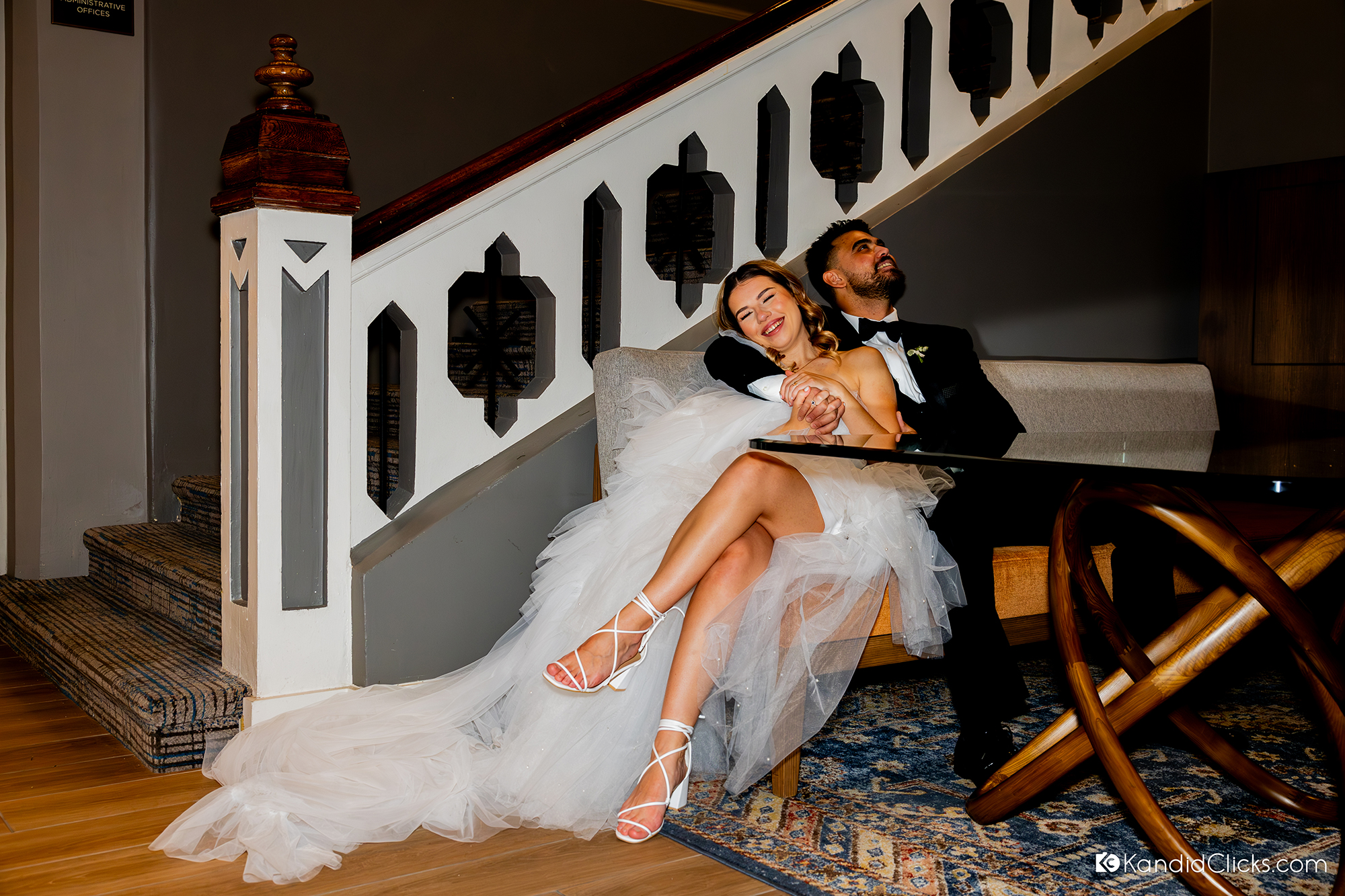
Creative flash wedding photos use techniques like direct flash, off-camera rim lighting, slow-shutter drag, color gels, and four-point dance floor setups to turn ordinary receptions into cinematic images. Night wedding photography balances ambient and flash exposure to capture dramatic backlit portraits and motion-blurred light trails. Moody wedding photography uses deep shadows, muted tones, and teal-and-orange color grading to build emotional, cinematic storytelling. Together, these techniques transform the after-dark hours into the most memorable images in your gallery.
That is the technical short answer. The full breakdown of recipes, camera settings, gear, and when to keep it simple is below.
The Photos That Make People Stop Scrolling Happen After Dark
There is a moment at almost every wedding when the energy shifts. The sun drops, the string lights come on, the dance floor fills, and the day stops being pretty and starts being electric. The trouble is that most photographers panic when the light disappears. They crank the ISO, the images turn grainy and muddy, and the most exciting part of your wedding ends up looking like a dim phone snapshot.
It does not have to be that way. With creative flash, deliberate night shooting, and intentional color grading, those after-dark hours become the single most dramatic, cinematic, memorable images in your entire gallery. This is the area where the gap between an experienced wedding photographer and a beginner is widest and most visible.

Why Flash Is Not the Enemy
Couples often flinch at the word flash because they picture the harsh, washed-out, red-eye disaster of a disposable camera. That is not creative flash. Used well, flash is not a crutch for darkness, it is a precision tool for sculpting light exactly where you want it. The look is borrowed straight from fashion editorials and that bold, unapologetic energy from Vogue and Harper’s Bazaar.
The whole art comes down to controlling two exposures at once: the ambient light of the room and the burst of light from your flash. Master that relationship and you can darken a chaotic background into cinematic shadow while your couple glows, perfectly lit, in the center.
Yes, professional wedding photographers use flash, and the best ones use it constantly. The reason it does not look like flash is that they are shaping and balancing it rather than just blasting it.
A Foundation: Direct, Bounce, and Off-Camera Flash
Three building blocks worth knowing before the recipes.
Direct flash fires straight at the subject from on or near the camera. It produces hard light, stark shadows, and bold editorial punch.
Bounce flash points the flash at a ceiling or wall first, so the light spreads and softens before reaching your subject. It is the go-to for natural-looking indoor coverage, though it needs a surface to bounce off.
Off-camera flash wedding photography takes the light off the camera entirely, onto a stand or an assistant’s hand, fired by a wireless trigger. This is where the real magic lives. Once the light is separated from the lens, you control direction, distance, and angle independently. That separation is what creates dimension and drama.

The High-Impact Creative Flash Wedding Photography Techniques
Direct flash and the nineties aesthetic
This is the look that came roaring back. An on-camera flash fired straight at your subjects, kept close, with a narrow aperture, throws a stark shadow onto the wall behind them and creates that nostalgic, editorial, party-snapshot vibe. Perfect for energetic, retro-feeling reception candids.
The recipe is precise. Keep your camera settings low so the background goes dark, shutter speed around 1/200, ISO at 100, and aperture as narrow as the scene needs, anywhere from f/8 in a bright room to f/2 on a dark dance floor. Then push your flash power high so your subject pops bright against that darkened background. If the light feels too harsh on sweaty or oily skin, soften it with a modifier like a MagSphere. It breaks every “soft light is better” rule on purpose, which is exactly why it reads as cool and intentional rather than amateur.
Off-camera rim lighting
This is where it gets cinematic. Place a flash on a stand directly behind the couple, aimed back toward the camera, and you carve a bright halo around their silhouette, separating them from the dark background and sculpting their edges with light. It is staggeringly effective in rain, snow, or fog, where the backlight catches every droplet and turns weather into atmosphere. A couple kissing in the rain, rimmed in light against a black sky, is the kind of image people frame on their wall.
Slow-shutter sync and the dance-floor drag
This technique captures motion and energy in a single frame. Drag the shutter slow, around 1/15 or 1/30 of a second, while the flash fires at the end of the exposure. You freeze your couple tack-sharp while the moving dance-floor lights smear into vibrant streaks of color around them. Move the camera slightly during the exposure for even more dynamic blur. Pure energy, light trails and motion wrapped around a crisp couple in the middle of the chaos.
Color gelling
Add colored gels, deep blues, sunset oranges, to your off-camera flashes and a bland banquet-hall wall transforms into a vibrant, stylized backdrop. Gels let you paint the environment, turning a beige conference room into a moody, colored stage. They are also essential for matching existing light.
The four-point dance floor setup
This is the pro move for receptions. Place flashes in all four corners of the dance floor, pointed inward at very low power, around 1/64 or 1/128. The entire floor is evenly, dramatically lit from every direction, and the photographer can move freely, shooting in any direction without dragging a light stand or relying on a ceiling bounce that may not exist. Magazine-quality candid shots all night long.

A Simple Framework: Compose, Expose, Light, Shoot
The order experienced shooters work in, an easy four-step rhythm.
Compose. Scout the scene and find your angle.
Expose for the ambient. Lower your ISO and raise your shutter speed or narrow your aperture until the background looks dark and cinematic.
Add and modify the light. Introduce your flash at low power to illuminate your subject perfectly without disturbing that dark, dramatic ambient look.
Pose and shoot. Direct the couple to interact naturally and focus purely on their expression and connection.
Almost every dramatic flash image follows that path.
Night Wedding Photography Techniques
Day-for-night moody flash
One of the most striking things you can do is make a sunny afternoon look like a dramatic, cinematic night.
Set a fast shutter speed, around 1/1000, and a low ISO, deliberately underexposing the ambient daylight until the world goes dark and moody. Shift your white balance down to roughly 3600 Kelvin so the scene takes on a cool, blue, nighttime mood. Then add a CTO, a color temperature orange gel, to your off-camera flash. That gel warms the light hitting your couple so they appear naturally lit inside a dark, blue-toned world. The contrast between the cool dark background and the warm lit subject is what sells the effect.
Shutter drag for atmospheric night shots
For atmospheric night and urban shots, you do not always want to freeze everything. Slow your shutter to between a quarter-second and a thirtieth, and move the camera slightly during the exposure while your flash keeps the couple sharp. City lights stretch into beautiful streaks, the crowd blurs into motion, and your subjects stay crisp at the center.
Gel matching to avoid the ugly color clash
A subtle pro detail that separates clean night work from amateurish results. If the ambient scene is lit by warm tungsten streetlights and you fire a neutral white flash, you get an unnatural blue-to-orange mismatch in the shadows. The fix is to gel your flash orange to match the warm ambient light, so the lit subject and background share a consistent color temperature.
The backlit night portrait as a reception send-off
Many seasoned photographers end the night with a single deliberate night shot, pulling the couple away from the dance floor for five quiet minutes. It gives the couple a breather, ends the evening on a high note, and reliably produces a portfolio image. Scout a frame you can backlight, a doorway, a tree, an interesting structure, or just an open field. Set an off-camera flash behind the couple, and let the light do the work.

Moody Wedding Photography and Color Grading
What moody wedding photography actually means
Moody, to be clear, does not mean sad. It means emotion, depth, and atmosphere. Cinematic storytelling through rich shadows and muted tones rather than bright, polished perfection. It leans into real life, the quiet in-between beats, the texture of fog or rain, the genuine expressions, and it relies on consistent shooting and editing to produce images that look like stills from a romantic film.
The teal-and-orange grading recipe
The teal-and-orange look is the staple of moody photography. Desaturate the mid-tones. Push the shadows toward deep blues and teals. Keep the highlights, especially skin tones, warm. That separation of cool shadow and warm skin is what gives moody images their cinematic depth. The skin stays alive and human while the world around it falls into rich darkness.
Embrace weather as an artistic tool
Moody photography leans on the environment itself. Fog, clouds, rain, twilight, and overcast light all become artistic tools rather than obstacles. They add texture and atmosphere a clear sunny sky never could.
A great moody grade is restrained. The goal is to preserve texture and embrace imperfection, not bury faces in murk. Our guide to wedding photography styles maps the full spectrum from light-and-airy to dark-and-moody, and our editorial wedding photography explainer covers where moody grading sits stylistically.

Shaping and Directing Light Like an Artist
Beyond flash and grading, the real craft is in modifying the light itself. Flat, uncontrolled light is what makes images feel cheap. A few tools change everything.
A grid attached to a softbox or beauty dish focuses the light tightly onto your subject and stops it spilling onto the background. A softbox spreads and softens the light for a gentler, romantic look. Negative fill is the opposite trick: place a black surface, a V-flat, on the shadow side of your subject to absorb stray bounce light, deepening shadows and instantly raising contrast. Gobos and optical snoots cast patterns, dappled light through a palm-leaf cutout or a focused pool of light in a dark room.
The Gear That Makes It Possible
You do not need a vast kit, and great photographers prove it is skill, not gear, that transforms a scene. A few reliable tools do the heavy lifting.
A robust wireless trigger system to control flash power off-camera seamlessly. A powerful portable off-camera strobe for bigger lighting setups in a compact body. A quality on-camera round-head flash with a magnetic modifier rim, the workhorse for direct and bounced light. Modifiers like a magnetic sphere diffuser or mini softbox to shape and soften harsh light.
When choosing a flash, weigh whether it has enough power for high ceilings, whether it works wirelessly out of the box or needs extra triggers, and how fast it recharges. A slow recharge means missed moments on a fast dance floor.
When to Keep It Simple Instead
Not every moment wants heavy creative lighting. A tender first dance often calls for soft, warm, natural-looking light rather than a four-point dramatic setup. Some couples genuinely prefer a bright, true-to-color reception over a dark, moody one. The mark of a great photographer is not using every technique on every frame, it is knowing which moment calls for restraint and which calls for the full cinematic treatment. Black-and-white conversion remains a timeless classic for high-energy candids when color would only distract.
Technique serves the moment, never the other way around.

How Kandid Clicks Photography Approaches Creative Lighting in Phoenix
Creative lighting is where we genuinely come alive. It is the clearest expression of our belief that a wedding photo should make you feel something. The Phoenix desert hands us extraordinary raw material, dramatic skies, deep dusk colors, the kind of open night where a single off-camera flash can make a couple look like they are standing inside a film still. We treat the reception not as the part of the day where the light runs out, but as the part where the real magic starts.
Our approach is always intentional. We carry the gear and the technique to light a dark dance floor, to rim a couple against a desert night, to drag a shutter and catch the energy of the celebration, but we use it in service of the moment rather than to show off. When the night calls for drama, we bring it. When it calls for a quiet, warmly lit slow dance, we read that too. See how that translates across a full day in our wedding and engagement photography work.
Final Thoughts on Creative Flash and Night Wedding Photography
Creative flash, night photography, and moody color grading turn the after-dark hours of your wedding from a forgettable blur into the most cinematic images in your gallery. The core techniques: direct flash, off-camera rim lighting, slow-shutter drag, color gels, and a four-point dance floor setup. Day-for-night flash with a 3600K white balance and a CTO gel pushes the drama further. Restrained teal-and-orange grading builds emotion in the edit. The right gear helps, but skill matters more.
Above all, the best photographers know when to deploy the full arsenal and when to let a moment stay soft and simple.
If you want a photographer who treats your reception as the main event rather than an afterthought, reach out through our contact page and let’s talk about how creative lighting can make your night unforgettable.

Frequently asked questions
What is moody wedding photography?
A: Moody wedding photography is a rich, atmospheric, cinematic style built on shadows, muted tones, and deep contrast rather than bright, even light. Despite the name, it is not about sadness. It is about emotion, depth, and drawing the viewer into the feeling of the moment through consistent shooting and editing.
Do wedding photographers use flash?
A: Yes. Many professional wedding photographers use flash for a large share of the day. It gives them control over light regardless of what the venue offers and is essential for sharp, vibrant images in dark receptions. Increasingly, flash is also a deliberate creative choice for bold editorial looks.
What is the difference between a flash and a speedlight?
A: A speedlight is a type of flash, the compact, portable unit that mounts on a camera or sits on a small stand. The broader term flash also includes larger, more powerful strobes used to light dance floors or overpower daylight. All speedlights are flashes, but not all flashes are speedlights.
What are the best settings for flash photography at night?
A: A reliable starting point is shutter speed around 1/200, ISO 100, and aperture chosen to control the background, narrower like f/8 in bright spaces and wider like f/2 on a dark dance floor. Raise flash power to make the subject pop. For motion effects, drag the shutter slower to 1/15 or 1/30.
Can you take wedding photos at night?
A: Absolutely. With off-camera flash, a wireless trigger, and patience, photographers create striking backlit portraits, sparkler exits, light-trail dance shots, and even star-filled images on clear nights. Night shots require the couple to hold still briefly for longer exposures but reliably produce frames that stand out.
How do you use flash for weddings without it looking harsh?
A: Shape and balance the light rather than blasting it. Bounce the flash off a ceiling or wall to soften it. Take it off-camera to control direction and add dimension. Add a diffuser or softbox to spread it. Balance flash power against ambient light. Match flash color to existing light with gels.
Who is a famous photographer known for using flash?
A: The bold direct-flash editorial look traces back to fashion and paparazzi photography in publications like Vogue, with many celebrated wedding and editorial photographers building careers on creative flash work. The technique itself has been popularized across many well-known names in modern wedding photography.
What is the 20-60-20 rule in photography?
A: The 20-60-20 rule is a loose guideline about balance, suggesting that meaningful impact comes from a smaller share of carefully chosen frames, with the bulk being solid execution and a final portion being standout creative shots. It is a rule of thumb, not a strict law.
Is dark and moody wedding photography right for me?
A: Dark and moody photography fits if you are drawn to rich, cinematic, emotional images and find bright, airy photos too polished. It pairs well with deeper jewel tones in styling, deep greens, burgundy, charcoal, velvet, and lace. If you prefer light, true-to-color brightness, a natural-light or light-and-airy style serves you better.
How much do top wedding photographers charge for flash work?
A: Pricing varies enormously by region, experience, and reputation. Elite internationally renowned wedding photographers can command many thousands of dollars and far higher. Most couples work with excellent local professionals at far more accessible rates. See our guide to wedding photographer costs for realistic local figures.