

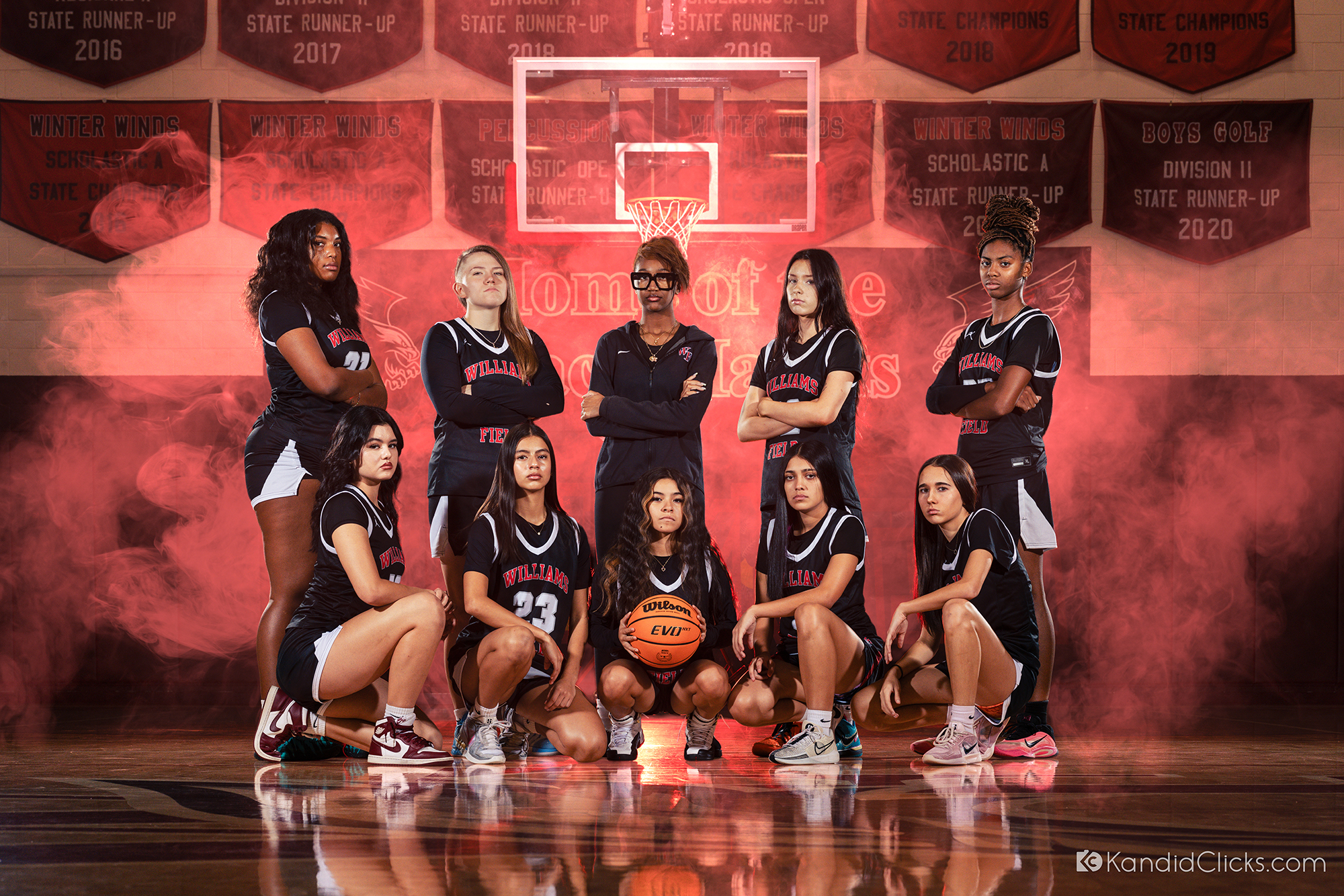
Team vs individual sports portraits solve different problems. A team session captures the roster as a unit and produces both group frames and short individual portraits within one booking. Individual athlete sessions build a dedicated portrait around one athlete, one sport, and typically one to three specific looks over 60 to 120 minutes. Team sessions win on efficiency and per-family cost when the goal is coordinated roster documentation. Individual sessions win on portrait depth, dramatic sports styling, and recruitment-portfolio quality when the goal is standout gallery work for one athlete. Many families and teams book both: a team session for the roster and separate individual sessions for the athletes who want portrait-grade images beyond what the team format can deliver.
We shoot both formats at Kandid Clicks Photography and often build hybrid arrangements that pull the strengths of each into a single plan. This guide walks through what each format actually delivers, when to book which, how to combine them, and how to plan the logistics for your squad. If you want the wider service context alongside this decision framework, our main page as a Phoenix sports portrait photographer covers how we approach sports work across every format.
What is the difference between team and individual sports portraits?
The two formats look similar at a distance but produce very different results.
A team sports portrait session is built around the whole roster. We arrive at an agreed location (a field, a gym, a park, or a studio setup) with a plan for the day. Athletes cycle through team-wide group compositions and short individual portrait setups within a compressed timeframe. The final gallery includes team frames, coach and staff frames, and individual roster portraits at a consistent style across every athlete. Team sessions are optimized for efficiency: one photographer covering 15 to 30 athletes in two to four hours produces images that document the roster as a cohesive unit.
An individual athlete session is built around one person. We spend 60 to 120 minutes on a single athlete with multiple lighting setups, wardrobe or gear changes, and dramatic portrait treatments that are not possible within the compressed timeframe of a team session. The final gallery includes 20 to 40 edited portraits designed as portfolio-quality images for that specific athlete.
The key distinction: team sessions capture the roster at scale; individual sessions capture one athlete in depth. Both are legitimate approaches to sports photography, and neither is a substitute for the other.

When to book a team sports portrait session
Team sports photography sessions work best in specific scenarios. Understanding when they are the right fit helps teams and families budget correctly and avoid buying coverage they will not use.
Roster documentation for the season
Every team benefits from a set of coordinated portrait images that mark the specific roster for a specific season. Rosters change year to year. Athletes graduate, transfer, or drop off. The team that fielded together this season may never be together in the same configuration again. A team session locks that specific roster into a permanent gallery. Our deep dive into the benefits of sports portraits for Phoenix youth teams walks through why this format matters especially for youth programs where roster turnover moves fast.
League or program requirements
Many organized youth leagues, club programs, and high school programs require or offer team photo day as part of the season. The team session produces the images used in yearbooks, league programs, gym walls, and roster banners.
Team gifts, awards, and end-of-season events
Team sessions produce the images used for team gift packages (framed prints for graduating athletes), award banquet displays, and end-of-season slideshows. If your program does any of these events, a team session is the source of the images.
Sponsor and program marketing
Team sessions produce the images used in program marketing: website rosters, social posts, sponsor materials, and recruitment content for the following season. Commercial rights may be required if the images are used in paid marketing, so confirm licensing at booking time.
Cost distribution across families
Team sessions distribute the base session cost across the whole roster. Compared to booking individual sessions for every athlete on the team, a team session is significantly more cost-efficient. Every family gets images of their athlete, plus team frames, at a lower per-family investment than a solo booking would require.
Efficient scheduling
Coordinating 20 separate individual sessions across 20 families is a scheduling nightmare. Coordinating one team session with 20 athletes present at the same location is a single logistics problem. For teams, individual bookings do not scale; team sessions do.

When to book an individual athlete session
Individual athlete sessions solve problems that team sessions cannot address. They work best in specific scenarios where the goal is portrait depth rather than roster documentation.
Recruitment portfolios
Athletes pursuing college recruitment need portrait-grade images for their recruitment portfolios, coach outreach packages, and social media presence. Team session portraits work for some purposes but rarely have the production value that stands out to college coaches reviewing hundreds of prospects.
Senior-year commemorative sessions
Graduating high school athletes finishing their sport often book dedicated individual sessions in their senior year. These sessions produce dramatic sports portraits, gear-focused close-ups, and cinematic frames that document the end of their high school athletic career. The final gallery becomes a keepsake in ways that team session portraits usually do not.
Athletes with a specific gallery vision
Some athletes want their sports portraits to look like magazine covers: dark moody lighting, hard rim light, dramatic wardrobe, and post-processing that reads as editorial rather than documentary. This aesthetic requires the time and production setup that only an individual session can provide.
Athletes competing at elite levels
Club sport athletes, travel-team athletes, and athletes at select or elite competition levels often need portrait-grade content for their own brand, sponsor outreach, or scholarship applications. Individual sessions produce this content at the required quality.
Athletes whose team does not offer a photo day
Not every team has an organized photo day. Adult recreational athletes, individual sport athletes (golf, tennis, martial arts, running), and athletes at programs without a team photography arrangement often book individual sessions as their only sports photography. Combat sport and grappling athletes have specific coverage requirements that differ from mainstream field sports; our post on martial arts and grappling photography action shots covers those specifics.
Athletes whose team photo day did not deliver what they wanted
Some families book individual sessions after receiving team photo day results that fell short of what they hoped for. Team sessions are optimized for efficient coverage; the depth of individual portraits is not part of that model.

Individual athlete session vs team session: what each actually delivers
The clearest way to understand the difference is to compare what each session type actually produces.
Team session deliverables
- Team-wide group compositions: formal lineup, huddle, informal group interaction frames
- Coach and staff portraits
- Individual roster portraits at a consistent style across every athlete, typically 3 to 5 edited images per athlete
- Sub-group frames: position groups, captains, seniors
- Team gallery delivered to the program or league with per-family purchase options
- Digital delivery through an online gallery with print product options
- Session length: 2 to 4 hours for a roster of 15 to 30 athletes
- Per-athlete cost: significantly lower than an individual session
Individual session deliverables
- 20 to 40 edited portrait images of one athlete
- Multiple lighting setups within the session
- One to three wardrobe or gear looks (game uniform, warm-up, portrait attire)
- Dramatic sports portrait treatment: rim lighting, low-key setups, cinematic color grading, composite effects if included
- Individual gallery delivered directly to the family
- Digital delivery with full personal-use rights
- Session length: 60 to 120 minutes on one athlete
- Cost: higher than the per-athlete cost of a team session, but includes significantly more per-image production
Both deliverables have real value. The question is which value fits your specific situation. Our full dramatic sports portraits prices and packages page breaks down what each format costs so you can compare individual and team scope against a written price framework.

How to book team sports photos: logistics that make it work
Team sessions have more moving parts than individual sessions. The teams that get great results plan the logistics thoroughly; the teams that treat photo day as an afterthought get lower-quality results even from the same photographer.
Assign a photo day coordinator
One parent or staff member takes responsibility for communicating with the photographer, coordinating with the roster, and running the day itself. Teams that leave communication to a group text with everyone on it usually stall out.
Lock in the date early
Photo day competes with games, practices, family schedules, and school events. Set the date at least six weeks in advance and communicate it to the whole roster. Reschedule attempts within two weeks of the session usually mean losing the photographer’s date entirely.
Coordinate the uniform and wardrobe
Every athlete should arrive in the specific uniform or wardrobe the team is using for the photo day. Home uniform vs away uniform, warm-up gear included or excluded, personal accessories allowed or not: these decisions should be made in advance and communicated in writing.
Set arrival time and check-in
Athletes should arrive 15 to 30 minutes before the session start time. Late arrivals delay every subsequent shot and shrink the individual portrait time available for on-time athletes. Set a firm check-in system: sign-in sheet, coach roll call, or a photo day coordinator with a roster list.
Order group frames before individuals
The team frame is the anchor of the gallery and is the most important shot of the day. Complete team-wide compositions first, while every athlete is present and the group has full energy. Individual portraits happen after the team frames are locked.
Plan for photo order
For efficiency, order the individual portraits by team position, jersey number, or alphabetical name. This keeps the flow organized and helps maintain consistent style across every athlete.
Bring extras
Water for the roster. A comb or brush for touch-ups. Safety pins for uniform adjustments. A backup uniform for anyone who forgot theirs. Small logistics that keep the session moving. Athletes and families thinking about long-term care of the fight kit, uniform, or gear used for the shoot can read our post on how to care for sports gear between sessions for practical storage guidance.
Communicate delivery expectations to families
Once the session is complete, families need to know when to expect the gallery, how to order prints or products, and what images will be available. Photographers deliver galleries; teams distribute the access.

How to book individual sports photos: logistics for a single-athlete session
Individual sessions are simpler to coordinate than team sessions but require careful advance planning to make full use of the longer session window.
Book six to eight weeks in advance
Peak season (August through November for fall sports, February through May for spring sports) fills earliest. Senior athletes in their final year of high school often book eight to twelve weeks ahead for their commemorative sessions.
Pre-session consultation
Individual sessions benefit from a detailed consultation before the shoot date. This conversation covers the athlete’s specific sport, gear, style preferences, session goals (recruitment portfolio, senior-year commemorative, brand content), wardrobe planning, and location choice. Sessions that skip the consultation often use session time inefficiently.
Location choice
Individual sessions can happen at a studio, on a field or court, at an outdoor location, or at a combination. The choice depends on the athlete’s sport and the intended gallery aesthetic. Sports that involve specific playing surfaces (baseball diamonds, tennis courts, wrestling mats) benefit from location shoots that include the surface. Sports without location-specific requirements often work best in controlled studio settings where dramatic lighting is available. For volleyball athletes specifically, our post on the best volleyball photographer in Phoenix covers court-specific considerations that transfer well to other net sports.
Wardrobe and gear planning
Individual sessions typically include one to three wardrobe or gear looks. Common combinations include: game uniform, warm-up gear, and a portrait outfit. Or game uniform plus sport-specific gear (helmet, bat, ball, cleats) plus a personal look. Plan the specific outfits and gear before the session so no time is lost during the shoot deciding.
Session flow
Individual sessions typically start with a warm-up setup to let the athlete get comfortable, move into the primary lighting setup for portrait frames, transition to a second setup for a different look, and close with the athlete’s most personality-forward frames.
Delivery expectations
Individual gallery delivery typically runs two to four weeks depending on the post-processing scope. Sessions with dramatic composite effects, sky replacements, or extensive color work take longer than sessions with clean natural or studio lighting.

Sports photography for entire team: combining team and individual sessions
Many programs and families end up combining both formats. The team session covers the roster documentation, and separate individual sessions cover the athletes who want portrait-depth work.
Team session as the base, individual sessions as add-ons
This is the most common structure. The team books a full team session for the roster. Families who want additional portrait-grade images book individual sessions separately, usually at the same photographer who ran the team session so the style stays consistent across both galleries.
Team session with extended individual time for select athletes
Some team sessions build in extended individual portrait time for graduating seniors, team captains, or scholarship-track athletes. The base team session covers the roster; the extended individual time gives specific athletes portrait-grade coverage within the same booking.
Individual sessions distributed across the season
Some teams book individual sessions for every athlete across a longer timeline rather than compressing everything into a single day. This works especially well for programs where different athletes have different peak seasons or where scheduling every athlete on the same day is not feasible.
Senior-only individual sessions
Some programs offer senior athletes an individual session as a graduation gift or program benefit, while underclass athletes participate only in the team session. This concentrates portrait-grade coverage on the athletes finishing their high school careers.

Sports team photo day in Phoenix: choosing between formats
The right choice for your squad depends on specific factors that vary team to team and family to family. Here is a framework for thinking through the decision.
Choose team sessions when: roster documentation is the primary goal, cost distribution across the whole team matters, the program has coordinated photo day requirements, images will be used for league or program marketing, or every athlete needs a consistent-style portrait for a specific purpose (yearbook, program).
Choose individual sessions when: portrait depth for one athlete matters more than roster coverage, the athlete is pursuing recruitment or a specific gallery vision, dramatic sports portrait treatment is the goal, senior-year commemorative documentation is the driver, or the athlete’s team does not offer photo day.
Choose both when: the team needs roster documentation and specific athletes need portrait-grade work, the family wants team images for shared galleries and dramatic images for the athlete’s own portfolio, or the program budget supports team coverage plus selective individual sessions for graduating athletes.
There is no wrong answer. The framework only exists to help you match the format to your actual goals so you do not end up paying for coverage that does not serve the outcome you want.
What to expect on team photo day in Phoenix
Team photo day runs smoother when the whole squad knows what to expect. The check-in and warm-up window happens first: athletes arrive in the specified uniform, sign in with the photo day coordinator, and gather at the shooting location. We confirm the shot list with the head coach or team captain before the first frame.
Team-wide compositions come next. The formal lineup goes first because it needs every athlete present and looking sharp. Alternate group compositions follow: huddle, informal group interaction, position-group breakdowns, senior groupings, and coach-with-team frames.
Individual rotation happens after the group frames are locked. Athletes cycle through the individual portrait setup in the order the photo day coordinator has organized. Each athlete gets 2 to 5 minutes at the individual setup depending on the roster size and the session length.
Coach and staff portraits close out the session. These often happen last because coaches manage the athletes through the earlier setups and become available once the roster is finished. The whole session typically runs 2 to 4 hours from arrival to teardown.

Frequently Asked Questions
Should we book team photos or individual sports portraits?
Book team photos when roster documentation is the primary goal and cost distribution across the whole squad matters. Book individual sports portraits when portrait depth, dramatic sports styling, or a specific athlete’s recruitment portfolio is the goal. Many families and teams book both: a team session for the roster and individual sessions for athletes who want portfolio-grade images.
How long does a team sports photography session take in Phoenix?
A team sports photography session typically runs two to four hours for a roster of 15 to 30 athletes. The session covers team-wide group compositions, coach and staff portraits, and individual roster portraits at a consistent style. Larger rosters (40+ athletes) may require longer session windows or multiple session blocks to maintain quality across every athlete.
Can we combine team photos and individual athlete sessions?
Yes. Combined arrangements are one of the most common formats we book. The team session covers the whole roster and produces group frames plus short individual portraits. Separate individual athlete sessions add dramatic portrait-depth coverage for athletes who want portfolio-grade images, senior-year commemorative work, or recruitment-portfolio content beyond what the team format delivers.
What questions should we ask before booking sports team photos?
Ask about session length, number of edited images per athlete, editing style included, delivery timeline and format, rescheduling policy, rights and licensing, and whether commercial-use rights are included for team marketing. Ask for a written scope statement alongside the quote so deliverables are documented. Ask whether hybrid arrangements combining team and individual coverage are supported.
Booking sports photography for your team or athlete
Whether you land on team, individual, or a hybrid arrangement, the first step is a conversation about what your team or athlete actually needs from the gallery. Every sports photography booking we take begins with a consultation where the session plan gets built around the specific goals rather than a fixed template. To start that conversation with a Phoenix sports photographer who runs both formats and can build a hybrid arrangement if that fits your situation better, get in touch with your roster count, sport, and rough timeline in hand.