

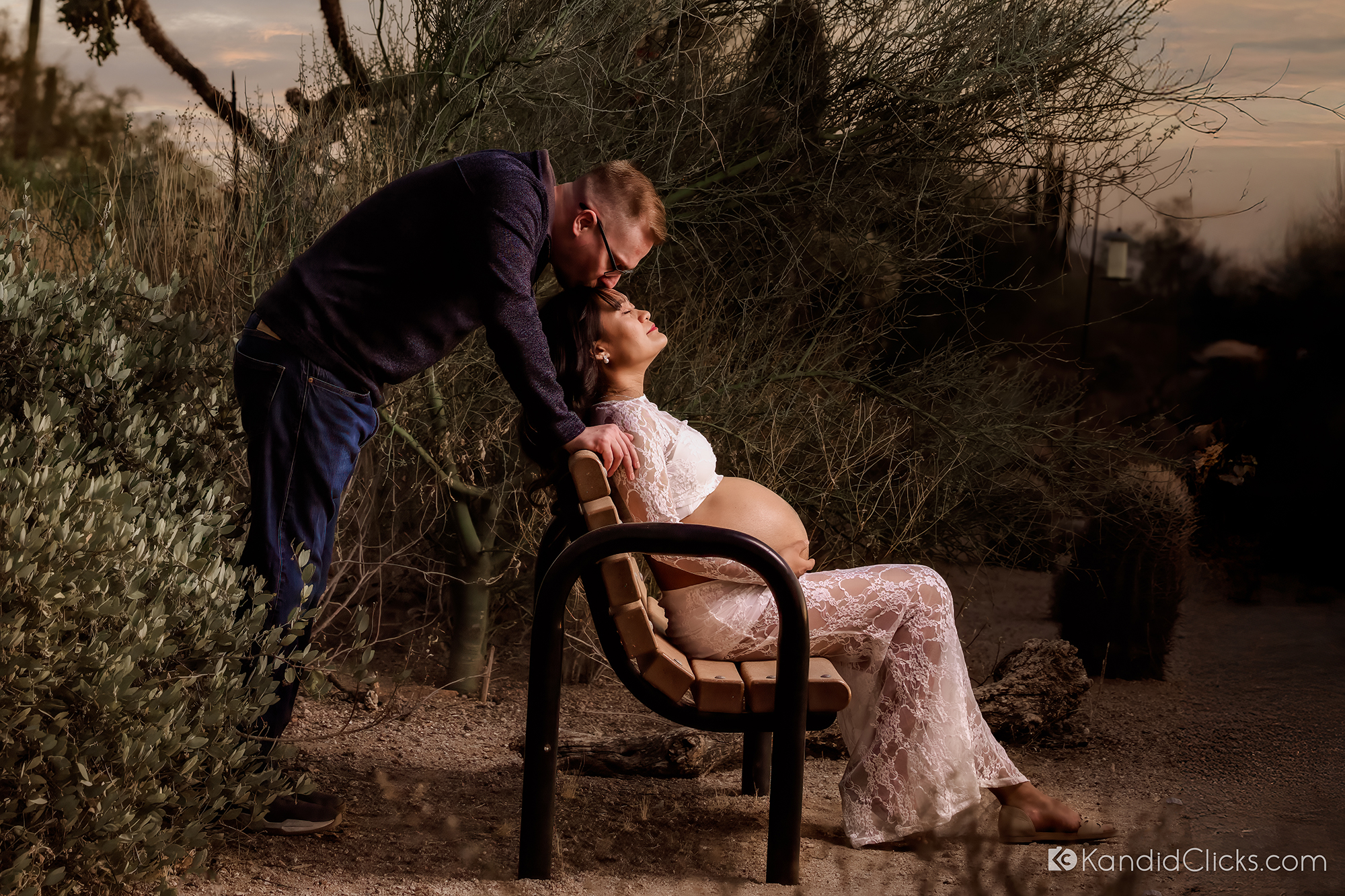
Start with heavily hydrated skin, choose a satin-finish foundation without SPF, add cream blush and bronzer for warmth, define eyes softly with waterproof mascara, and lock everything in with a matte setting spray. That is the short answer. The longer answer depends on when your session falls in the Phoenix calendar, whether you are shooting outdoors or in a studio, and how your skin is behaving during pregnancy. Maternity makeup here is different from maternity makeup in most other parts of the country. Our desert dry air pulls moisture out of your skin all year, our summer heat can dissolve foundation in twenty minutes, and our monsoon humidity (July through September) does the opposite, making powder cake and setting spray refuse to dry. Every product choice and every application technique in this guide is built around those specific Phoenix conditions.
This guide focuses on maternity photoshoots specifically. Pregnant skin behaves differently from non-pregnant skin: hormonal shifts change oil production, sensitivity, and pigmentation, and safer ingredient choices matter more during pregnancy than at any other time. If you are looking for makeup guidance for a non-maternity outdoor session (senior portraits, family photos, or engagement pictures), our separate post on makeup tips for outdoor senior, family, and engagement photos covers those three occasions. This post stays focused on maternity, so every product choice, every timing recommendation, and every mistake to avoid is framed for the pregnant body and for Phoenix conditions specifically. We are a husband-and-wife maternity photographers team based in Phoenix, Arizona, and everything below comes from what we have seen work through summer, monsoon, and mild months with a Phoenix maternity photographer lens.
The short answer: what actually works for maternity photos in Phoenix
For a fast checklist that applies to almost every Phoenix maternity session:
- Deeply hydrated skin, prepped for at least two weeks
- A satin-finish foundation without SPF, matched to your neck
- Cream blush and cream bronzer for a natural flush
- Neutral, matte eyeshadow with waterproof mascara
- A rosy or dusty-nude lip in a long-wear satin formula
- Matte setting spray to lock everything in for heat
- A touch-up kit with blotting sheets, powder, and lip color
- A trial run at home one week before your session
Every choice on that list is explained in the sections below, along with what changes if your session is in July heat versus February morning cool, and what changes if you are dealing with pregnancy-specific skin issues like melasma or hormonal breakouts.

Why maternity makeup is different from any other kind of makeup
Two things make maternity makeup its own category. First, pregnant skin behaves differently from non-pregnant skin. Second, maternity sessions ask more of your face than most other portrait sessions.
Pregnancy hormones (specifically estrogen and progesterone) change how your skin behaves. Some pregnancies produce the classic “pregnancy glow,” which is real and comes from increased blood flow and oil production. Other pregnancies produce breakouts, sensitivity, redness, or melasma (also called chloasma or “pregnancy mask,” which is darker pigmentation across the cheeks, forehead, and upper lip). Your skin at thirty weeks pregnant is not the same skin you had before pregnancy, and it is not the skin you will have after. Working with what your skin is doing right now, in this pregnancy, is the honest starting point.
Maternity sessions also ask more of your face than a typical portrait sitting. You may be photographed for an hour to an hour and a half. Emotions run high; happy tears are common. Poses involve standing, walking on uneven ground for outdoor sessions, hands cupped under the bump, and (especially in Phoenix summer) real heat exposure. Regular everyday makeup formulas that lasted through your workday before you were pregnant may not last through a maternity session, especially outdoors in warm months.
The final piece, and the one that separates maternity makeup from every other type of photo makeup: ingredient safety. During pregnancy, most obstetricians and dermatologists recommend avoiding certain skincare and makeup ingredients that are otherwise fine. This is a real consideration for a maternity shoot, not a marketing point. We will get to which ingredients to look at more carefully below.
Everything else in this guide is built around these three ideas: prep for your current pregnant skin, choose formulas that hold up under Phoenix session conditions, and check ingredients for pregnancy safety.
Skin prep for the Phoenix desert climate
Skin prep matters more in Phoenix than in almost any other climate, and it matters more during pregnancy than at any other time in your life. Both of those factors compound, so a maternity session in Phoenix asks for the most careful skin prep of any portrait session you may ever book. Start two weeks out. That is not padding. That is the real timeline.
Why desert dry air makes hydration matter more than anywhere else
Phoenix humidity averages around thirty percent for most of the year, and can drop into the teens in the winter and spring. For comparison, most of the American East Coast averages fifty to seventy percent humidity. Dry air pulls moisture out of skin continuously. Skin that is well-hydrated in Chicago or Atlanta can arrive dehydrated in Phoenix within a week.
Dehydrated skin does two specific things that ruin makeup: it flakes under foundation, and it makes fine lines look deeper. Neither of these problems can be fixed with more moisturizer on the morning of your shoot. They have to be addressed over the two weeks leading up to your session. Drink more water than you think you need. Eat foods with high water content (cucumber, watermelon, oranges, leafy greens). Run a humidifier at night, especially in your bedroom, in the dry winter months.
Two weeks out: hydrate from the inside and out
Two weeks before your session, start a consistent skincare routine and stick to it. This is not the window for experimenting with new products. Any new active ingredient can trigger irritation or breakouts in the first two to three weeks of use. During pregnancy, your skin is already more reactive than usual, so new-product testing is even riskier than normal. Whatever you are already using and know works, keep using.
Add hydration wherever you can. A hyaluronic acid serum (pregnancy-safe and widely available) applied morning and night pulls moisture into the top layers of your skin. A rich but non-clogging moisturizer over the serum locks it in. If your usual moisturizer is a lightweight everyday formula, consider swapping to a richer overnight cream for the two weeks before your session.
Skip any strong chemical exfoliants, professional facials, chemical peels, or new dermatological treatments in this window. Save those for after your baby is born.
The week of: humidifier, sheet masks, and no harsh actives
The week of the session is a maintenance week. Continue your hydration routine. Add a sheet mask two or three times during the week for extra moisture. A hydrating gel mask worn for ten to fifteen minutes before bed is another gentle option. Skip anything foaming, exfoliating, or treatment-based.
Run a humidifier in your bedroom every night this week. Dry desert air overnight can leave you waking up with flaky skin, tight cheeks, and a chapped lip line no matter how good your evening skincare was. A humidifier is an underrated Phoenix maternity prep tool.
Skip alcohol (which you would be doing during pregnancy anyway) and cut back on very salty food. Both contribute to facial puffiness. Get consistent sleep. Puffy eyes and a tired face show up in every image, and no makeup fully corrects them.
The night before: sleep, low sodium, no last-minute experiments
Eat a normal, low-sodium dinner. Drink a full glass of water before bed. Get eight or nine hours of sleep if you can. Sleep on your left side or on your back with pillows for support, both of which are common comfortable pregnancy positions. Sleeping face-down on one side can leave morning creases across the cheek that take an hour or more to fade.
Do not test any new product tonight. Do not try a face mask you have never worn. Do not tint your brows. Do not use a new hairspray or dry shampoo you have not tested. Every new thing in the twenty-four hours before a session is a potential problem you cannot predict.
The morning of: cleanse, moisturize, sunscreen carefully
Cleanse with your usual gentle cleanser. Do not scrub or use hot water. Pat dry. Apply your hyaluronic acid serum and let it absorb for a minute. Apply your moisturizer and let it fully absorb, at least five minutes, before any makeup goes on.
Sunscreen during pregnancy is where things get careful. Chemical sunscreens (avobenzone, oxybenzone, octinoxate) are increasingly under scrutiny for pregnancy safety, and many obstetricians now recommend mineral sunscreens (zinc oxide, titanium dioxide) instead. The trade-off is that mineral sunscreens can leave a white cast that shows up on camera, especially under bright Phoenix sun.
The workaround for a maternity session: use a tinted mineral sunscreen (many now come in shades to match skin tone), apply a very thin layer, and give it a full ten minutes to absorb before foundation. This gives you real sun protection with minimal camera flashback. Skip pure white mineral sunscreens for the morning of the shoot unless you have tested them with your foundation and know they blend without cast.

Pregnancy-safe skincare and makeup ingredients
This is the single biggest reason maternity makeup is its own category. During pregnancy, several common skincare and makeup ingredients are commonly advised to be avoided or used with caution. What follows is general guidance based on what obstetricians and dermatologists commonly recommend, not personal medical advice. Every pregnancy is different, and you should ask your own OB or dermatologist about any specific product you have questions about. That said, here is a working overview.
Ingredients most doctors advise avoiding during pregnancy
Retinoids and retinol (vitamin A derivatives): commonly avoided across the board during pregnancy due to concerns about developmental effects. Look at ingredient labels for retinol, retinyl palmitate, retinaldehyde, tretinoin, and adapalene. If any of these appear in your regular skincare or in a makeup primer, most obstetricians recommend switching to a different formula during pregnancy.
High-strength salicylic acid: often used in acne products. Low concentrations (up to two percent) in leave-on products are usually considered safe, but higher concentrations (peels, strong toners) are commonly avoided. If you have hormonal breakouts during pregnancy and want to treat them, ask your obstetrician about safe alternatives.
Hydroquinone: a skin-lightening ingredient sometimes used to treat melasma. Commonly avoided during pregnancy due to high absorption through skin. If you are dealing with pregnancy-related pigmentation, look at ingredient-safe alternatives (like vitamin C serums or niacinamide) rather than hydroquinone.
Chemical sunscreens: as noted above, mineral alternatives are widely recommended during pregnancy.
Certain essential oils and fragrances: some essential oils are commonly avoided during pregnancy. Heavy fragrance in a foundation or setting spray can also trigger nausea during the first trimester and increased sensitivity throughout pregnancy. Fragrance-free formulas are a safer default.
Phthalates: often found in fragrance and in some nail polishes. Look for “phthalate-free” labeling.
What ``pregnancy-safe`` means for makeup
“Pregnancy-safe” is a marketing term without strict regulation. A product labeled pregnancy-safe by the manufacturer has usually removed the most commonly-flagged ingredients (retinoids, high-strength salicylic acid, hydroquinone, phthalates, and often synthetic fragrance), but there is no third-party certification standard. Read the actual ingredient list rather than relying on the label claim.
The good news is that the ingredients on the concern list are more common in skincare than in makeup. Most standard foundations, blushes, mascaras, and lipsticks do not contain them. Where they tend to show up is in acne treatments, anti-aging products, and some primers marketed as “smoothing” or “wrinkle-erasing.” Read labels on those specifically.
How to read a label quickly
Look at the ingredient list on any product you plan to use for your maternity session. If you see any of these words in the first ten ingredients (which is where the highest concentrations sit), consider swapping the product:
- Retinol, retinyl palmitate, retinaldehyde, tretinoin, adapalene, hydroquinone, salicylic acid at higher than two percent, phthalates, and any essential oil you know is on your obstetrician’s caution list.
- If you are unsure about a specific ingredient, put the ingredient name plus “pregnancy” into a search. Reputable maternity and dermatology sites (as well as your own doctor) can give you a clearer read on any single ingredient than a general blog post can.
When to ask your OB about a product
If you have a specific skin condition (severe melasma, cystic acne, rosacea, eczema flares) that you are actively treating during pregnancy, ask your obstetrician before your session about which of your current products are safe to continue. Do not stop a prescribed medication for a photoshoot without checking. Do not add a new active ingredient to treat something for the shoot without asking either. Your doctor knows your specific situation better than any general guide.
Nothing in this post is personal medical advice. It is general information that should be checked against your own doctor’s guidance for anything specific.

Foundation for the pregnancy glow without heavy coverage
Foundation is the biggest single decision in maternity makeup. The wrong foundation flattens the natural glow that pregnancy hormones create. The right foundation enhances it.
Skip foundations with SPF for camera work
Foundations with SPF over 15, especially mineral sunscreens (zinc oxide and titanium dioxide) built into the formula, reflect camera light and create a white cast on the face. Under indoor studio flash it shows up as a ghostly pallor. Under bright Phoenix outdoor sun it can lift your face out of tone with the rest of your body.
For your maternity session, choose a foundation without SPF, or with SPF under 15. Apply a separate pregnancy-safe mineral sunscreen underneath, and give it a full ten minutes to absorb before the foundation goes on. This gives you real sun protection without the flashback.
Match to your neck, not your face
Your face and your neck are almost always slightly different colors, especially in Phoenix where the face gets more sun. Foundation matched to your face color often leaves a visible line at the jaw. Foundation matched to your neck disappears seamlessly.
Test foundation on the underside of your jaw in natural daylight. Try two or three shades side by side and step outside into shade to see which one blends into your neck. Pregnancy can also slightly shift your skin tone, so a foundation that was your perfect match six months ago may not match today. Retest before your session.
Satin over matte for the pregnancy glow
Full matte foundation flattens the natural luminosity of pregnant skin. Full dewy foundation reads as sweaty and greasy under Phoenix outdoor light. The middle ground, satin finish, gives you a soft luminosity that photographs as glow without shine.
Look for foundations labeled satin, natural finish, or luminous. Skip anything labeled “high shine,” “wet look,” or “extreme matte.” A satin finish photographs as healthy skin, which is what you want.
Medium coverage, not full coverage
Heavy full-coverage foundation makes skin look like a mask on camera. Medium coverage evens tone while still letting the natural texture of your skin come through. For maternity photos specifically, this matters even more than for other sessions, because the “pregnancy glow” is partly a function of skin texture. Cover it up with a thick foundation and the glow goes with it.
Build coverage in thin layers. Start with a light pass of foundation across the whole face. Let it set for thirty seconds. Add concealer only where you need more coverage: under the eyes, over any specific breakouts, over any patches of melasma. Blend with a damp beauty sponge, which absorbs excess product and leaves a thinner, more natural layer than a brush.
Foundation choices by skin tone
For fair complexions, look for a warm-neutral or peach-neutral base rather than pure pink. Pink undertones can read flushed on camera in warm Phoenix light. Yellow and warm neutral foundations photograph most naturally on fair skin under desert sun.
For light-to-medium complexions, warm undertones (peach, gold, honey) usually work best outdoors. Cool-toned foundations can look ashy or gray under natural light.
For medium-to-olive complexions, warm and neutral bases both work well. Yellow-based foundations are usually the safest choice. Anything too orange can read heavy.
For deep complexions, undertone matters more than lightness. Look for red, orange, or golden undertones based on your natural warmth. Foundations that read too gray or ashy will look flat. A slight sheen (satin, not shimmer) photographs beautifully on deeper skin tones in outdoor light.
Test in natural daylight, not indoor bathroom lighting. What looks right in a store’s fluorescent light often looks completely different in Phoenix outdoor light at three in the afternoon.
Covering melasma without heavy layering
Melasma (the “pregnancy mask” that shows up as darker patches on the cheeks, forehead, upper lip, or jawline) is one of the most common cosmetic concerns during pregnancy. It is caused by increased melanin production driven by hormones, and it usually fades after birth. For your session, the goal is to soften the contrast rather than fully cover, because full cover requires a heavy layer that flattens the whole face.
Apply your regular foundation first. Then, over the melasma areas only, apply a slightly more pigmented concealer with a small brush, patting it in rather than swiping. Blend the edges. Add a very light second layer only where the pigmentation is still visible. Set only that area with a small amount of powder to lock the concealer in place.
Skip the temptation to over-cover. Slightly visible melasma on camera reads as natural skin texture. Heavy coverage over melasma reads as makeup, which is worse.

Setting powder that does not flatten the glow
Setting powder locks foundation in place and controls shine. In Phoenix, it is more important than in most climates. During pregnancy, it needs to be used more carefully than at any other time.
T-zone only for maternity makeup
Powder the forehead, nose, and chin. Leave the cheeks, temples, and undereyes alone. Cheeks are where light naturally hits your face in most maternity poses, and a matte cheek reads flat and drained. A natural-finish or satin cheek reads dimensional and glowing.
If you have oily skin generally, add a very light dust across the whole face. If you have combination or dry skin (which many women develop during pregnancy), keep powder off the cheeks entirely.
Silica-heavy powders and flashback
Silica is common in translucent setting powders. It absorbs oil and creates a soft-focus effect on skin. It also reflects camera light in a way that can register as a pale halo around the T-zone, especially under flash. For studio maternity sessions with flash, avoid silica-heavy powders. Look for powders formulated as HD-friendly, or use rice powder or a cornstarch-based translucent powder instead.
For outdoor Phoenix sessions in natural light, silica is less problematic but still worth testing before session day. Take a phone selfie with flash after applying setting powder. If you see a bright halo around the powdered area, switch to a different formula.
Blotting sheets are the real Arizona answer
In Phoenix outdoor sessions, blotting sheets do a job that powder cannot. Powder controls shine by adding a layer on top of your skin. In heat, that layer mixes with fresh sweat and turns cakey and uneven. Blotting sheets remove the oil and sweat without adding anything to your face.
Pack a full pack of blotting sheets in your session bag. Between setups, blot the T-zone gently by pressing (not rubbing) the sheet against the skin. Then, if you still need more matte finish, tap on a small amount of translucent powder. Blot first, powder second, never the reverse. This is one of the highest-return small habits you can build for a Phoenix outdoor maternity session.
Blotting sheets are the real Arizona answer
In Phoenix outdoor sessions, blotting sheets do a job that powder cannot. Powder controls shine by adding a layer on top of your skin. In heat, that layer mixes with fresh sweat and turns cakey and uneven. Blotting sheets remove the oil and sweat without adding anything to your face.
Pack a full pack of blotting sheets in your session bag. Between setups, blot the T-zone gently by pressing (not rubbing) the sheet against the skin. Then, if you still need more matte finish, tap on a small amount of translucent powder. Blot first, powder second, never the reverse. This is one of the highest-return small habits you can build for a Phoenix outdoor maternity session.

Cream blush and bronzer for dimension
Cameras flatten faces. Pregnancy hormones give you a natural flush that you should build on rather than cover. Cream products do both jobs better than powders for maternity makeup.
Why cream over powder for pregnancy skin
Cream blush blends into pregnant skin instead of sitting on top of it. It reads as a natural flush rather than as a layer of product. It also does not draw attention to any fine lines or dry patches the way powder can. Apply cream blush after foundation and before setting powder. Blend with a damp beauty sponge or with clean fingertips. Set only with a light dust of powder around (not on) the blushed area.
If you already use powder blush and love it, powder is fine. Just apply lightly and blend thoroughly. The mistake to avoid is heavy powder blush over dry pregnancy skin, which can look chalky in outdoor Phoenix light.
Where to place blush for a bump-forward portrait
Standard blush application (apples of the cheeks, swept slightly up toward the temples) works for most maternity poses. If your session includes a lot of side-profile bump-focused images, add a tiny amount of blush slightly higher on the cheekbone as well. This adds warmth to your face in profile, where you can otherwise look pale next to the illuminated bump line.
Peach and warm rose blushes photograph beautifully on most skin tones in Phoenix outdoor light. Cool pinks can read too cool against warm desert backgrounds. Berry and plum blushes work well on medium-to-deep skin tones for indoor studio sessions.
Skip heavy contour lines
Heavy visible contour reads as makeup on camera and pulls attention away from your bump, which is the visual anchor of every maternity image. Skip the sharp cheekbone contour stripe entirely for maternity photos. If you want subtle dimension, use a warm cream bronzer applied lightly to the temples, along the jawline, and slightly under the cheekbones, blended thoroughly.
Match bronzer to your undertone. Warm-toned bronzers on cool-undertoned skin can read orange. Cool-toned bronzers on warm-undertoned skin can read muddy. Test on the jawline in natural daylight before committing.
Skip glittery highlighter for outdoor sessions
Highlighter with visible glitter or coarse shimmer catches Phoenix sun as bright reflective points on the face. It reads as grease or hot spots rather than glow on camera. For outdoor maternity sessions, skip glitter highlighter entirely. If you love highlighter, choose a soft satin finish (not metallic) applied very lightly to the tops of the cheekbones and the inner corners of the eyes.
For indoor studio sessions with controlled lighting, a bit more highlighter is fine. Studio light is more forgiving than direct sun.

Eyes: soft definition that survives tears
Maternity sessions produce more emotional moments than most other portrait sessions. Happy tears at seeing the images on your photographer’s camera. Deep emotions during a first pregnancy. Reflection on your body doing this remarkable thing. Whatever mascara you wear needs to survive all of that.
Neutral eyeshadow that reads on camera
Warm browns, soft taupes, warm beige, and muted mauves all photograph as polished on camera. Reserve bold colors for indoor studio sessions where lighting is controlled. For outdoor Phoenix sessions, stick to a neutral palette.
The standard three-shadow application works well: a light shade across the lid, a medium shade in the crease for depth, a slightly darker shade blended into the outer corner for definition. Blend every edge thoroughly. Skip glittery shadows entirely for outdoor daytime sessions, because sun catches shimmer particles as harsh reflection points.
Filled brows that hold through wind and heat
Well-groomed brows frame the face and make the difference between “polished” and “casual” on camera. Fill sparse areas with a brow pencil, powder, or pomade matched to your natural brow color. Use short, hair-like strokes instead of a solid line. Blend with a spoolie brush. Set with a clear brow gel to hold shape through wind and Phoenix heat.
Get any brow shaping (waxing, threading, tinting) done at least three days before your session. Redness from waxing takes twenty-four to seventy-two hours to fade, and pregnancy skin often stays red longer than usual.
Waterproof mascara is essential
For maternity sessions, waterproof mascara is not optional. Wind causes watering eyes. Emotional moments cause tears. Sweat on the upper lash line runs into mascara. Non-waterproof formulas smudge in any of these scenarios. Waterproof holds.
Apply two coats to the upper lashes. Curl your lashes before mascara. Skip lower-lash mascara for outdoor sessions if you tend to smudge, or apply one very light coat and blot excess against a tissue before touching your lashes.
Choose a warm brown mascara if you want a softer look, or black for more definition. Pregnancy sometimes makes eyes appear tired or shadowed, and slightly stronger lash definition can offset that in your images.
When to skip false lashes
Individual flare lashes on the outer corners give a subtle lift that photographs beautifully. A full strip of dense false lashes can make eyes look smaller on camera and often reads as heavy for a soft maternity look. If you love false lashes, choose a lightweight wispy style rather than a dense dramatic one.
Adhesive on false lashes takes time to cure. Apply at least one hour before the session. Never test false lashes for the first time on session day. Do a full trial at least a week before.
Lash extensions applied at a professional salon are a strong alternative. They photograph consistently, do not need daily application, and do not shift in Phoenix heat. Book extensions at least three days before your session so any allergic reaction (rare, but possible, and slightly more likely during pregnancy) has time to show up.
Lips: color that survives a long maternity session
Maternity sessions often run longer than typical portrait sessions, especially outdoor ones that include multiple locations, outfit changes, and slower posing for comfort. Lip color has to hold through all of it.
Rosy nude or dusty rose over bright red
A soft rosy nude, a dusty rose, a warm mauve, or a peachy nude photograph as “you but glowing” in maternity images. Colors that match your natural lip exactly can read invisible on camera. One shade deeper than your everyday lip color is the sweet spot.
Bright red lips can work for editorial or studio maternity sessions, but they pull the visual focus away from the bump in outdoor natural-light sessions. If you love a bold lip, save it for a specific styled indoor look. For most outdoor maternity sessions, keep the lip soft.
Satin over gloss
Sticky gloss picks up hair in Phoenix wind, which is present almost year-round. Full high-shine gloss reflects sun as bright spots on the lip that read as flare on camera. Satin and matte finishes photograph cleanly and hold up better through a long session.
If you want dimension without gloss, use a satin liquid lipstick or a lightweight tinted balm with a slight sheen. Both give shape and softness without the reflective flare of a heavy gloss.
Long-wear formulas that hold in Arizona heat
Standard traditional lipstick, especially waxy formulas, softens and shifts in Phoenix heat. Long-wear or transfer-resistant liquid lipsticks hold better. The trade-off is that liquid lipsticks can feel drying, and pregnancy already tends to leave lips dry.
Prep lips carefully: apply lip balm twenty to thirty minutes before makeup, blot the excess with a tissue right before applying color, then apply color in thin layers. A properly prepped lip in a long-wear formula can hold for three to four hours in Phoenix heat.
Layer for staying power
For maximum longevity in a long or hot session, layer:
Lip liner in a shade close to your lip color, filling the entire lip (not just the outline). Then long-wear lip color on top. Blot lightly with a tissue. Apply a very thin second layer only where color has come off. Skip gloss unless you specifically want the shine, and if you do, add it only for a few specific shots and blot before continuing.
Carry the same lip color in your session bag for touch-ups. A quick reapplication between setups keeps color consistent across your gallery.

Setting spray: the Phoenix step you cannot skip
Setting spray in Phoenix is not optional. It is the difference between makeup that holds for the whole session and makeup that starts breaking down within thirty minutes of arriving on location.
Matte setting spray in Phoenix heat
For any Phoenix maternity session between April and October, choose a matte-finish setting spray. Dewy or radiant setting sprays can amplify shine and sun reflection on the face at midday and during warm afternoons. Matte setting sprays lock everything in with a natural-finish result that photographs cleanly.
For cool-month sessions (November through March) a natural-finish or slightly luminous setting spray works well, because the softer light and cooler temperatures reduce the risk of shine amplification.
How to apply setting spray
Hold the bottle six to eight inches from your face and mist in an X and T pattern to cover the whole face evenly. Do not over-saturate. Let it air dry for at least one minute. Do not blot, wipe, or wave while it is wet, because movement can shift product before it locks in place.
If you wear contact lenses, close your eyes fully for the mist and keep them closed until it dries. Some setting sprays can irritate eyes during application.
Reapplying between outfit changes
For sessions with multiple outfit changes, plan a mid-session touch-up before each new outfit. Blot the face with a blotting sheet, tap on a small amount of translucent powder only where needed (T-zone), re-mist with setting spray, and let it dry before the next outfit goes on. This resets your makeup to close-to-fresh without a full reapplication.
For monsoon-season sessions (July through September) reapply setting spray more sparingly than usual. Humid air keeps the spray wet longer, and too much can leave the face feeling tacky.

How Phoenix outdoor light affects your maternity makeup
Outdoor light in Phoenix is not uniform. It changes by hour, by season, and by weather. Each variation changes how your makeup reads on camera. Understanding the light helps you make better product choices.
Golden hour warms every tone by one to two shades
Golden hour (roughly the 60 to 90 minutes before sunset) is when most maternity sessions in Phoenix are shot. Light is warm, low, and directional. It flatters skin beautifully, but it also warms every color on your face by one to two shades. Pink blush reads more peach. Cool nude lipstick reads warmer. Neutral eyeshadow reads slightly gold.
If your session is scheduled for golden hour and you want your makeup to read as it does in the mirror, pull back on warm tones and lean slightly cooler in your palette to compensate. If you love the warm read of golden hour on your face, wear your normal warm palette and let the light amplify it. Most maternity clients love how golden hour warms their skin, which is why we shoot most sessions in this window.
Midday sun shows every texture
Midday sun (roughly 11 am to 3 pm) is the hardest light for portrait photography in Phoenix. The sun is nearly overhead, casting hard shadows under the eyes, nose, and chin. Every skin texture is visible. Every shine on the face is amplified. Foundation that looks smooth in your mirror shows every fine line and dry patch under midday sun.
Skilled photographers rarely shoot outdoor maternity sessions at midday for these reasons. If your session has to happen at midday for any reason, keep makeup ultra-matte, use less product than usual, blot aggressively, and expect touch-ups every fifteen to twenty minutes. Consider shifting to open shade for the whole shoot rather than direct sun.
Blue hour cools everything
Blue hour (the 15 to 25 minutes after sunset) is soft, cool, and evenly diffused. Skin reads slightly cooler on camera. Warm blushes read more mauve. Warm lips read more berry.
For blue hour maternity sessions, lean into cooler makeup tones intentionally. Cool-toned blushes, mauve or berry lips, and slightly deeper eye definition photograph beautifully in blue hour light. Add a small amount of satin highlighter on the cheekbones because the diffused light will not create as much natural facial dimension as harder light does.
Overcast days: the hidden gift
Overcast days are the easiest light for portrait photography. Cloud cover diffuses the sun into a giant softbox. Faces have no harsh shadows. Colors read accurately. Every makeup choice reads on camera close to how it looks in your mirror.
Phoenix does not have many overcast days, but when one falls on your session date, it is a gift. Your makeup will read exactly as intended, and the shoot can happen at any time of day rather than being locked to golden hour.

How Arizona heat affects makeup longevity
Phoenix heat is the single biggest factor that affects how long your maternity makeup lasts on the day of the shoot. Between April and October, and especially June through September, heat management is part of your makeup plan.
The physics of sweat and foundation on pregnant skin
Pregnancy raises your body temperature. Metabolic rate increases. Blood volume increases. Sweating increases. All of this is normal. In moderate weather it is not a problem. In one-hundred-plus-degree Phoenix summer heat, it becomes a real factor in how long your makeup lasts.
Sweat is water plus salt plus a small amount of oil. Most foundations use water or oil as their binding agent. When sweat meets a water-based foundation, the water in the sweat dissolves the binders and the foundation starts to move. Long-wear or sweat-resistant foundations are formulated to resist this. During pregnancy in Phoenix summer, they are essentially required, not optional.
Cream vs powder in triple-digit heat
Conventional wisdom says powder is better for oily skin. In Phoenix summer heat, this is not always true. Powder mixes with sweat and turns cakey and uneven on the skin surface. Cream products melt slightly but often blend smoothly into the skin instead of caking.
The specific rule for maternity summer sessions: use cream products for coverage (cream foundation, cream blush, cream bronzer), then set only where needed with a very thin layer of translucent powder on the T-zone. This gives you the buildable coverage of cream with the longevity of a light powder set.
Long-wear vs waterproof vs transfer-resistant
Terminology on makeup packaging is not always precise. A working translation for maternity session prep:
- Waterproof: resists water directly, including tears. Usually mascara and eyeliner.
- Water-resistant: holds against water for a limited time, often thirty to forty minutes.
- Long-wear or long-lasting: designed to resist smudging, fading, and transfer over an extended period. Not always water-resistant.
- Transfer-resistant or transfer-proof: designed to resist rubbing off onto clothing, other faces, or hands. Common in liquid lipsticks.
For a Phoenix summer maternity session, prioritize long-wear labeling on foundation, waterproof on mascara, and transfer-resistant on lips.
A pre-session cooling routine (safe for pregnancy)
The single best thing you can do for makeup longevity is arrive at the session cool, not hot. If you arrive already sweating, no formula will save your makeup.
Get ready inside air conditioning. Do makeup with a fan on. Drive with the air conditioning high. Bring ice water in your bottle and drink it steadily. A cold pack (wrapped in a towel to avoid direct skin contact) held on the back of the neck for a few minutes before you leave the car can buy you an extra thirty to sixty minutes of fresh makeup once the session starts. Cool the body before the shoot, not during.
Pregnancy also brings extra fatigue and lower heat tolerance than most people are used to. If you feel lightheaded, dizzy, or too warm at any point in the session, tell your photographer and take a break. Every reputable photographer builds session pacing around the client’s comfort. This is especially true for maternity sessions.

Monsoon humidity and your maternity makeup: July through September
Phoenix monsoon runs from mid-June through September, with the most humid days typically falling between mid-July and mid-September. Humidity changes how makeup performs. Powder settles more heavily. Cream products can feel greasy. Setting spray takes longer to dry.
What monsoon does to setting spray and powder
Humid air keeps setting spray wet on your face for longer. In dry conditions, a mist of setting spray dries in about thirty seconds. In monsoon humidity, it can take two minutes or more. If you touch or blot your face while it is still wet, you disturb the makeup underneath.
Powder also behaves differently in humid air. It absorbs moisture from the air, gets slightly damp, and stops absorbing oil from your skin as effectively. This is why powder can feel like it does nothing on a truly humid Phoenix August afternoon.
Adjustments for humid maternity sessions
For monsoon-season sessions, lean cream over powder even more than in dry heat. Set only the T-zone with a very light dust of powder. Use matte setting spray sparingly. Blotting sheets are more important than powder for mid-session touch-ups.
Bring extra hair pins because humidity fights every attempt to keep hair in shape. If you have naturally curly or wavy hair, embrace the humidity rather than fighting it. Straightened hair usually loses its shape within thirty minutes of humid outdoor exposure, so a natural texture look often photographs better than a fresh blowout.
Backup plans for monsoon weather cancellations
Monsoon storms also mean sudden weather. A perfectly clear afternoon can become a dust storm and thunderstorm in thirty minutes. Have a backup plan with your photographer for weather-related reschedules, and keep your touch-up kit in a sealed bag so a sudden downpour does not ruin it.
For clients due in late summer whose ideal maternity session week falls in monsoon, studio sessions become a genuine alternative. Studio removes weather risk entirely and lets you shoot in fully-controlled climate. This is worth considering if your due date does not give you the option to shift the shoot into cooler months.

Studio vs outdoor maternity makeup in Phoenix
Because of Phoenix summer heat and monsoon weather, more maternity sessions here happen in studio than in most other parts of the country. Studio sessions have different makeup considerations than outdoor sessions, and understanding both helps you plan.
Why so many Phoenix maternity sessions happen in studio
Between May and September, outdoor sessions are limited to sunrise or short late-evening windows because of heat safety. Sunrise means being on location at 5:30 am, which for many pregnant clients is a hard sell. Studio removes all of that. The temperature is controlled. The light is consistent. Weather is not a factor. There is no walking on desert trails or over uneven ground. For late-pregnancy comfort in Phoenix summer, studio is often the practical answer.
Studio lighting and makeup adjustments
Studio lighting is stronger and more directional than outdoor natural light. Foundation coverage that reads natural outdoors can read heavy under studio flash. Powder that looks fine in outdoor light can flash back under studio strobes. Adjust makeup slightly for studio:
Use lighter foundation coverage than for outdoor. Skip silica-heavy setting powder in favor of an HD-friendly translucent powder. Skip any product with strong shimmer or metallic finish, because studio flash amplifies both. Neutral tones photograph most naturally under studio light.
Studio also lets you use slightly bolder color choices than outdoor because the lighting is controlled. If you love a bold lip or a deeper eye but skipped it for outdoor concerns, studio is where it can come back in.
Same look, different formulas depending on venue
The overall makeup approach (satin base, cream blush, neutral eyes, soft lip) works for both studio and outdoor. What changes is the specific formulas and the finishing steps. Outdoor sessions in Phoenix demand long-wear formulas, matte setting spray, and heavier setting for heat. Studio sessions can use lighter formulas, softer setting, and slightly more finish products because the environment is stable.
If you are unsure which environment your session will be in, ask your photographer. Many Phoenix maternity photographers offer combined sessions (studio segment plus a short outdoor segment at golden hour), which lets you get the studio-quality controlled images plus the outdoor-warmth cinematic images in the same session.

Coordinating your makeup with your maternity outfit
Makeup that ignores your outfit palette photographs mismatched. A cool-toned makeup palette against a warm rust gown reads off. A warm palette against a cool blue gown reads off in the other direction. Coordinate.
Pull one or two colors from your outfit and let those inform your blush, lip, and eyeshadow choices. A warm rust or terracotta gown coordinates with peach or coral blush and a warm rosy lip. A soft ivory or blush gown coordinates with a soft rose blush and a nude lip. A deep emerald or navy gown coordinates with a mauve or berry blush and a slightly deeper lip color.
For an outfit strategy, our guide on what to wear for outdoor maternity photos walks through color palettes, silhouettes, and fabric choices for Phoenix outdoor sessions in detail. Read that alongside this guide when planning your look. If you do not want to shop for a new gown, our sessions include access to a curated client closet of maternity gowns in sizes small through XXL. Trying on gowns in person helps you see which palette works with your skin tone under real light, which makes your makeup choices easier by the time session day arrives.
Timing your makeup with your session week
The right week to shoot your maternity session (usually 28 to 34 weeks for a first pregnancy, 28 to 32 weeks for a second, 24 to 28 weeks for twins) also affects your makeup plan. Later-pregnancy skin is often more dehydrated and more prone to melasma than earlier third-trimester skin. Skin sensitivity often peaks in the last month.
If your body allows a choice, shooting at 30 to 32 weeks gives you slightly easier skin conditions to work with than 34 to 36 weeks, on top of the general comfort advantage of shooting before late-pregnancy fatigue. For a full breakdown of the best time for maternity photos week by week, our timing guide walks through the tradeoffs for each stage. Read it before finalizing your session date if you are still choosing.
Should you hire a makeup artist for your maternity session?
Hiring a professional is worth it for some maternity clients and unnecessary for others. Here is an honest read.
When hiring a pro is worth it
For most Phoenix maternity clients, a professional makeup artist adds real value if:
- You rarely wear makeup and want a polished look without figuring out formulas on your own
- You are dealing with pregnancy-specific skin concerns (breakouts, melasma, sensitivity) that benefit from expert cover
- You want to remove one item from a stressful pre-session morning
- Your session is in Phoenix summer or monsoon and you want products that will genuinely last through heat
- You have concerns about pregnancy-safe ingredients and would rather someone else vetted the products for you
A photo-experienced makeup artist uses camera-friendly products, applies with technique specific to photography, and knows how to make makeup last through Phoenix conditions. Many Phoenix maternity photographers can recommend artists who specialize in pregnancy-safe formulations.
When doing your own makeup is the right call
Doing your own makeup is fine if:
- You wear makeup regularly and know what works on your face
- Your session is short (under an hour) and in cool conditions
- Your personal style is minimal and a full pro look would feel out of character
- Your budget is better spent elsewhere in the session
- You want the comfort of your own routine on a day that already has other planning
If you are on the fence, doing your own makeup with a good routine, tested products, and a real touch-up plan works well for most maternity clients.
How to find a Phoenix maternity-experienced makeup artist
Ask your photographer for recommendations first. Photographers work with makeup artists regularly and know who does great work on pregnant skin specifically. Ask for portfolios of maternity client work under natural outdoor light, not studio editorial images. Ask about their experience with Phoenix summer sessions.
Look for artists who specifically mention pregnancy-safe products in their service descriptions. This is not universal in the industry, and finding an artist who prioritizes it makes the maternity conversation easier.
Ask about pregnancy-safe product options before booking
Before booking, ask:
- Do you offer pregnancy-safe formulations, and can you accommodate specific ingredient preferences?
- What products do you use for long-wear in Arizona heat?
- Will you travel to my location, or is it studio-based?
- How much time do you need before the session starts?
- What is your reschedule policy for pregnancy-related reasons (early labor, doctor recommendations)?
Clear answers on these questions make session day smooth. Vague answers are a signal to keep looking.

A trial run one week before your maternity session
A trial run is more important for maternity photos than for most other portrait sessions. During pregnancy, your skin can change unpredictably from week to week. A product that worked fine at 26 weeks may behave differently at 30. A trial run one week before your session tells you what your skin is doing right now, in the exact skin state you will be shooting in.
Do your intended look start to finish. Wear it for six to eight hours around the house. Note anything that shifts, fades, or reads differently on camera than you expected. Take phone photos in natural light at the 30-minute, 3-hour, and 6-hour mark. Look at those photos before you look in the mirror. The camera tells you what the fabric of your makeup actually looks like on film, which is not always what your mirror shows.
Check specifically for: foundation oxidizing (turning slightly orange over time), lip color migrating or feathering, eyeliner smudging, mascara flaking, blush fading, and setting spray leaving a tacky feel. Fix what you can before session day. Change what you cannot.
Makeup mistakes to avoid for maternity photos
Most makeup problems on a maternity session day trace to a specific short list of avoidable mistakes.
Foundations with high SPF cause flashback
SPF 15 and higher, especially mineral SPFs (zinc oxide, titanium dioxide) built into foundation, reflect camera light and cause a white cast. Use a foundation without SPF, and apply a separate mineral sunscreen underneath. Give the sunscreen ten minutes to absorb before foundation goes on.
Heavy shimmer highlighter reflects wrong outdoors
Chunky glitter and metallic highlighter catch bright Phoenix sun as sharp reflective points that read as grease. Choose a satin-finish highlighter, applied lightly and only to the tops of the cheekbones.
Extreme contour lines look patchy in outdoor light
Heavy contour that shows visible stripes reads as makeup on camera. For maternity photos, skip the sharp contour entirely. Use warm cream bronzer applied lightly and blended thoroughly for subtle dimension.
Extreme under-eye brightening creates a ghostly effect
Using a concealer significantly lighter than your skin tone under the eyes creates a bright band that reads as a mask on camera under flash. Choose a concealer at your skin tone or one shade lighter, not multiple shades lighter.
Dark, heavy eye makeup can make eyes look tired
Full smoky eyes in dark shadows can make eyes appear smaller and more tired on camera, which is the opposite of what you want in maternity photos. Choose warm neutrals with soft depth in the crease instead. Save dramatic eye makeup for other occasions.
Silica-heavy powders can cause flashback under studio flash
For studio maternity sessions with flash, silica-heavy setting powders can leave a white halo on camera. Choose HD-friendly translucent powder or rice powder for studio sessions. Test with a phone flash selfie before session day.
Skipping the trial run
Doing your intended session makeup start to finish at least once, a week before the shoot, catches products that oxidize, formulas that do not hold up, and application choices that read differently on camera than in a mirror. Skipping this step is the source of most session-day makeup problems.
Fake tan applied the night before
Self-tanner applied within twenty-four hours of the session almost always looks orange in images and streaky in movement. Skin sensitivity during pregnancy can also change how self-tanner develops. If you tan, do it four to five days before the session, and consider skipping it entirely if you have not used the specific product during this pregnancy.
Waxing eyebrows the day before
Waxing (brows, upper lip, chin) leaves visible redness for twelve to seventy-two hours, and pregnancy skin often stays red longer than usual. Book any facial waxing at least three days before your session, ideally five.
Chapped or unprepped lips under matte lipstick
Matte lipstick sits on top of dry skin and exaggerates every flake and crack. Pregnancy already tends to leave lips drier than usual. Prep lips with a lip scrub two nights before the session and again the night before. Apply lip balm twenty to thirty minutes before makeup. Blot excess balm before applying color.
Using new products for the first time on session day
Any new foundation, mascara, lipstick, or setting spray can behave unpredictably on your skin. Break in every product for at least one full day of normal wear before your session. Pregnant skin is even more likely than usual to react to new formulas, so this is especially important during pregnancy.
Skipping desert hydration prep
Two weeks of consistent hydration (water, hyaluronic acid serum, rich moisturizer, humidifier) is the biggest single input into how your makeup photographs on session day. This is not skippable in Phoenix. Dehydrated pregnant skin under Arizona sun will flake under any foundation, no matter how expensive.

Touch-up kit essentials for your maternity session
A real touch-up kit takes fifteen minutes to pack and saves the second half of your session. For a maternity session specifically, include:
- Blotting sheets (one full pack)
- Translucent powder in a compact you can carry
- The exact lip color from your base look
- A small mirror larger than a phone screen
- A small brush for powder application
- Lip balm or chapstick for reapplication if needed
- A small hair brush and a few hair pins
- A water bottle with a straw (protects lipstick and keeps you hydrated)
- A small towel or facial tissues for gentle sweat wipes
- An extra hair tie in your color
- A snack (fruit, nuts, or a light bar for blood sugar stability)
- A small folding stool or portable chair for rest between setups (many pregnant clients appreciate this)
- Fashion tape for outfit adjustments
For Phoenix summer sessions add: a portable handheld fan, an extra bottle of water, and a cooling cloth or wet washcloth in a plastic bag. For monsoon sessions add: an umbrella or a light rain jacket in a bag, and a spare hair tie for humidity control.
Pack the kit in a small bag you can hand to your photographer or a family member to hold during the session. Everything should be reachable in under ten seconds when you need it.

Frequently asked questions about maternity photoshoot makeup
How do I do makeup for a maternity photoshoot?
Start by hydrating your skin for two weeks before the session, then prime and apply a foundation without SPF matched to your neck. Define your eyes softly with neutral shades and waterproof mascara, add cream blush on the cheeks, and finish with a long-lasting lip color. Lock everything in with a matte setting spray to survive Phoenix heat.
What is the best color to wear for maternity pictures?
Soft solid colors photograph beautifully in Phoenix maternity images. Warm earth tones like cream, camel, rust, and warm blush complement most desert backgrounds and let your skin glow through. Skip busy patterns and bright neons, which can distract from the bump and reflect onto your skin under Arizona sun.
Should you keep your hair up or down for a maternity photoshoot?
Hair style is personal. Loose waves or curls create a soft romantic look. An updo or half-up style highlights your face and makeup. In Phoenix summer or monsoon humidity, hair worn up often photographs cleaner because heat and moisture fight against a fresh blowout. In cool months, hair worn down holds shape more reliably.
Should I get my makeup done for maternity photos, or do it myself?
Both work. Hiring a professional is worth it if you rarely wear makeup, have specific pregnancy skin concerns, or want to remove effort from session morning. Doing your own is fine if you wear makeup daily and know what photographs well for you. Whichever you choose, do a full trial run one week before the shoot.
How do I prevent makeup from looking shiny in photos?
Use an oil-control primer if your skin is oily, apply translucent powder on the T-zone (never the whole face), and finish with a matte setting spray. In Phoenix outdoor sessions, keep blotting sheets in your session bag and blot before powdering. Skip glossy highlighter and dewy foundations for daytime outdoor shoots.
How do I cover dark circles and tired eyes for photos?
Hydrate well for two weeks before shooting and get consistent sleep. On makeup day, apply a peachy or neutral-toned concealer under the eyes and blend gently. Set with a little powder so it does not crease. A small amount of highlighter in the inner corners of the eyes brightens the whole eye area.
How is photoshoot makeup different from everyday makeup?
Photo makeup uses slightly more color than everyday, because cameras soften pigments. It also demands longer wear and specific product choices: no SPF in foundation, no heavy shimmer, no chunky glitter. In Phoenix specifically, photo makeup also has to survive heat, dry air, and possible monsoon humidity, which everyday makeup rarely gets tested against.
Can I wear my normal foundation, or should I get a special kind?
Your everyday foundation works if it matches your neck, does not contain SPF over 15, and has a satin or natural finish. If it contains higher SPF or has a fully matte or fully dewy finish, consider a different formula for your session. Test in natural daylight before deciding.
What are the best colors for my eyes and lips in a maternity photoshoot?
Neutral warm tones (taupe, bronze, warm brown, muted mauve) flatter almost every skin tone and photograph naturally on eyes. For lips, rosy nude, dusty rose, warm mauve, and peachy nude all photograph beautifully. One shade deeper than your everyday lip is the sweet spot. Skip bright red for outdoor daytime sessions.
Should I contour and highlight for my maternity photos?
Light bronzer for warmth and a subtle satin highlighter on the cheekbones work well. Skip heavy contour lines and glittery highlighter, both of which read as makeup on camera and pull attention off the bump. Cream products blend more naturally on pregnant skin than powders, and they photograph softer in outdoor light.
What should I do to prep my skin in the days leading up to the shoot?
Start two weeks out. Drink more water than usual. Apply hyaluronic acid serum and a rich moisturizer morning and night. Run a humidifier at night, especially in dry winter months. Skip new products, chemical peels, and professional facials. Sleep consistently. Phoenix desert air pulls moisture from skin faster than most climates, which is why two weeks matters.
Are there any makeup ingredients I should avoid during pregnancy?
Most obstetricians recommend avoiding retinoids (retinol, retinyl palmitate, tretinoin), high-strength salicylic acid, hydroquinone, and often chemical sunscreens during pregnancy. Mineral sunscreens are widely recommended instead. This is general guidance, not personal medical advice. Ask your OB or dermatologist about any specific product you have questions about, and check labels carefully.
Is it necessary to do a trial run of my makeup?
Yes, especially for maternity sessions. Pregnant skin can change from week to week, so a trial run one week before the session tells you what your skin is doing right now. Test your intended look for six to eight hours, take phone photos in natural light, and note anything that shifts, fades, or reads differently on camera than you expected.
What makeup lasts through Phoenix heat during a maternity shoot?
Long-wear or sweat-resistant foundation, waterproof mascara, transfer-resistant liquid lipstick, and matte setting spray hold up best. Cream products often outperform powder in triple-digit heat because powder mixes with sweat and cakes. Blot with blotting sheets for mid-session touch-ups, not more powder. Arrive at the session cool, not already warm.
How does monsoon humidity change my maternity makeup approach?
Humidity keeps setting spray wet longer and reduces how well powder absorbs oil. Lean cream over powder for monsoon sessions (July through September), set only the T-zone lightly, and use setting spray sparingly. Blotting sheets become more important than powder for touch-ups. Bring extra hair pins because humidity fights every attempt to keep hair styled.
What if I have melasma or pregnancy mask on my face?
Apply your regular foundation first, then use a slightly more pigmented concealer over the melasma areas only, patting it in with a brush. Blend edges and set only that area with a small amount of powder. Skip the temptation to over-cover. Slightly visible melasma reads as natural skin. Heavy layered coverage reads as makeup, which photographs worse.
Should I adjust my makeup for a golden-hour outdoor session in Phoenix?
Golden hour warms every tone by one to two shades on camera. If you want your makeup to read as it does in your mirror, lean slightly cooler in your palette to compensate. If you love the warm read of golden hour on skin, wear your normal warm palette and let the light amplify it.
Is mineral sunscreen okay under my maternity photo makeup?
Yes, and it is often preferable during pregnancy because most obstetricians recommend mineral over chemical sunscreens. The tradeoff is that mineral sunscreens can cause white cast on camera. Use a tinted mineral sunscreen matched to your skin tone, apply a very thin layer, and give it ten full minutes to absorb before foundation goes on.
Ready to plan your maternity session
The best maternity makeup is the makeup that photographs as your own skin at its most rested, radiant, and pregnant self. That is not about product names or expensive brands. It is about hydrating your skin for two weeks before the shoot, choosing formulas that hold up under Phoenix conditions (heat, dry air, monsoon humidity), coordinating your palette with your outfit, and avoiding a short list of specific mistakes. Trial-run one week ahead. Pack a real touch-up kit. Arrive cool. When you are ready to book, our maternity photography packages include a pre-session planning call to walk through your specific session date, your ideal shoot window, whether studio or outdoor is right for your due date, and any specific concerns about your skin or comfort during pregnancy. Bring the ultrasound. Bring the tiny shoes. Bring yourself as you are right now. We will handle the light.